
Objective balance data, in the session.
Turn “balance improved” into a number your referrals and payers accept — a lumbar sensor, an app, and reports built for physical therapists.
The documentation gap
“Balance improved” isn’t a measurement.
Referrals, payers, and progress notes ask for objective change. Without instrumented data, balance progress is recorded from observation alone — hard to defend at reimbursement, hard to compare session to session, and easy to undervalue.
Subjective by default
“Steady with min assist” is a judgment call. It doesn’t quantify sway, strategy, or change over time.
Lab-grade is out of reach
Force plates and motion-capture deliver the numbers — at a price and footprint most clinics can’t justify.
Progress goes unproven
Real gains in postural control are hard to show a patient or a payer when nothing on the chart is a number.
What ANVA measures
The ANVA Balance Framework.
ANVA evaluates balance across six interconnected domains — a more complete picture of how balance is functioning than a single pass/fail score. Each domain answers a different clinical question.
Balance Capacity
How much balance reserve do you have?
The amount of movement a person can tolerate before stability is lost.
Stability Utilization
How much of your reserve are you using?
The percentage of available balance capacity being used during a task.
Continuous Stability Control
How effectively do you control balance?
The quality, consistency, and efficiency of ongoing postural control.
Balance Recovery
What happens when balance is challenged?
The body’s ability to recognize instability and restore control.
Balance Adaptability
How well do you respond when conditions change?
The ability to maintain balance under progressively more challenging demands.
Balance Endurance
Can you sustain performance over time?
The ability to maintain stability, control, and efficiency throughout an activity.
In the session
From clip-on to objective report in three steps.
1
Clip the sensor
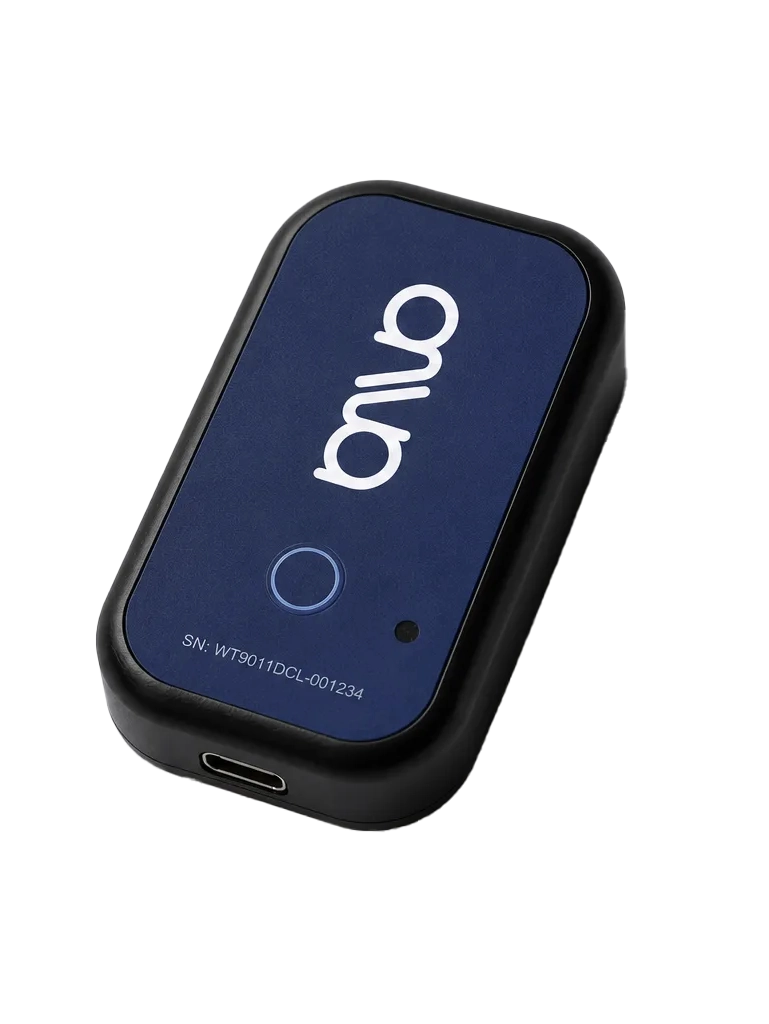
Attach the lumbar IMU at the low back in seconds. No wiring, no calibration room, no lab.
2
Run the assessment
Guide the patient through balance tasks or a built exercise session. The sensor streams trunk motion to the app in real time.
3
Read the report
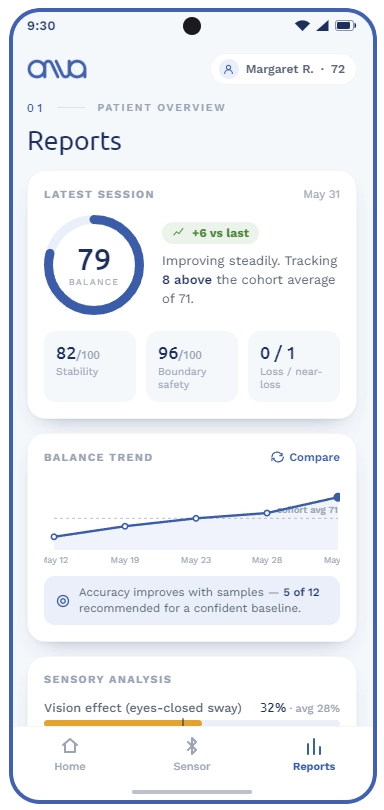
Get objective postural-stability metrics with session-to-session comparison — ready for your notes and referrals.
The app
Build the session. Sync the sensor. Mirror it to the screen.
- Session builder — assemble assessments and exercise sets for the patient in front of you.
- Live sensor sync — pair the lumbar IMU and see trunk motion as it happens.
- TV mirroring — cast cues and targets to a clinic screen so the patient can follow along.
- Reports & comparison — objective metrics, side-by-side across sessions.
Exercise library
A production-shot library of balance & movement exercises.
Filter by what the session needs — type, difficulty, focus area, and equipment — the same way you do in the app. Clean demo clips, built for the clinic. The full library unlocks on PRO.
Filter by: Type · Difficulty · Focus Area · Equipment
Semi-tandem shift
Postural Stability · Beginner
Weight transfer, foam
Weight Transfer · Moderate
Tandem gait
Gait & Balance · Moderate–Hard
Pricing
One device. Pro is optional.
ANVA Device + Free
$129 one-time
Sensor + lifetime ANVA Free: assessment, training, and objective reports. No subscription.
PRO
$10 / month
Everything in Free plus AI-assisted insights, trend analysis, and enhanced clinical reporting.
Put a number on balance.
Start free, in your own clinic. No lab, no long onboarding — clip the sensor and run a session.